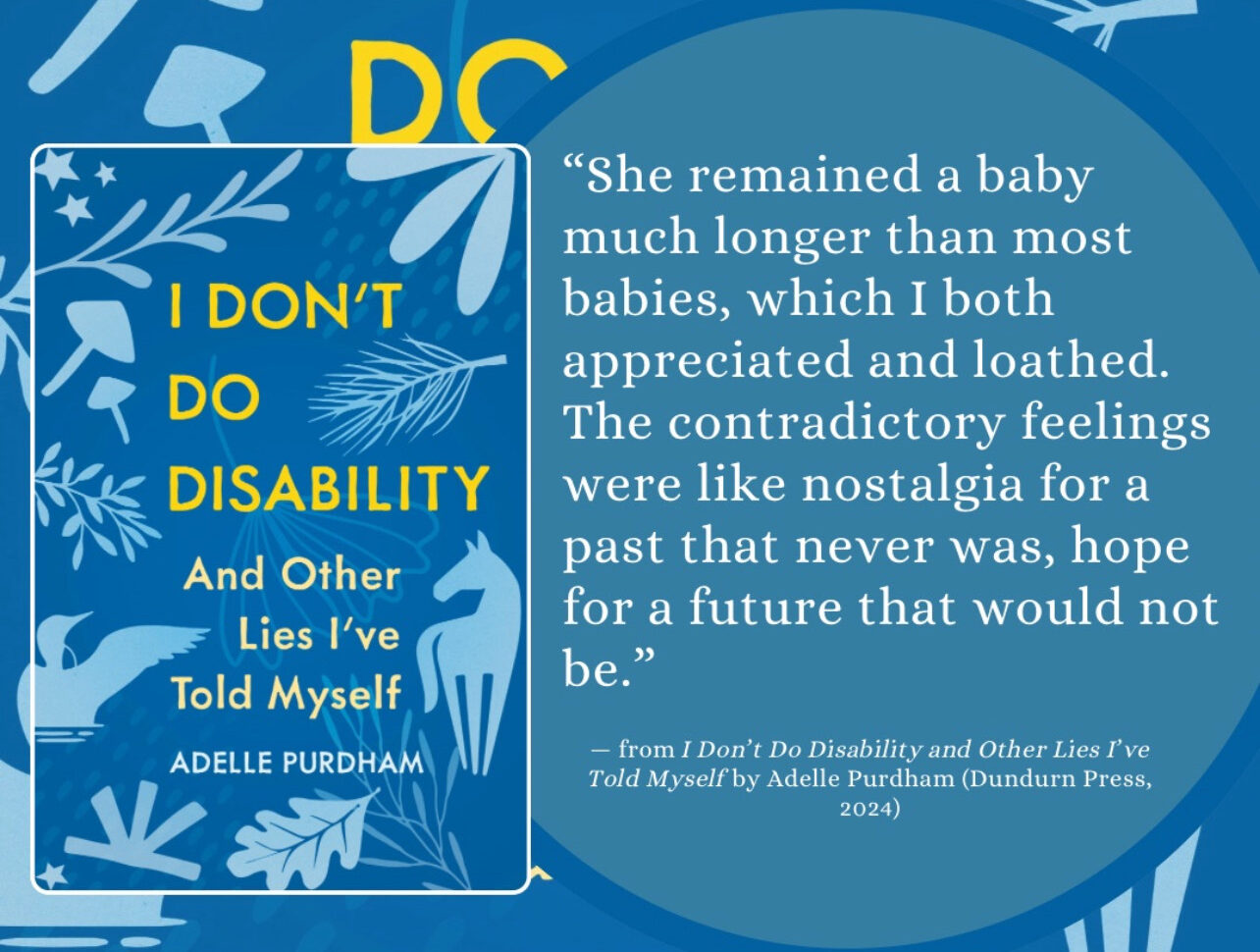
In her bestselling collection of essays, I Don’t Do Disability and Other Lies I’ve Told Myself, writer Adelle Purdham shares some of her experience as mother to a child with Down syndrome, offering a raw and intimate portrait of family, love, life, relationships and disability.
With the arrival of her daughter with Down syndrome, Adelle Purdham began unpacking a lifetime of her own ableism.
In a society where people with disabilities remain largely invisible, what does it mean to parent such a child? And simultaneously, what does it mean as a mother, a writer and a woman to truly be seen?
The candid essays in I Don’t Do Disability and Other Lies I’ve Told Myself glimmer with humanity and passion, and explore ideas of motherhood, disability and worth. Purdham delves into grief, rage, injustice, privilege, female friendship, marriage and desire in a voice that is loudly empathetic, unapologetic and true. While examining the dichotomies inside of herself, she leads us to consider the flaws in society, showing us the beauty, resilience, chaos and wild within us all.
Before it dies, a Douglas fir, half a millennium old, will send its storehouse of chemicals back down into its roots and out through its fungal partners, donating its riches to the community pool in a last will and testament. We might well call these ancient benefactors Giving Trees. — The Overstory, by Richard Powers
MY NEPHEW ROWAN’S birthday is in early June, when the spring flowers of my in-laws’ replete gardens bloom and appear in their full resplendence. I crack open the hard cover of the book Dan and I have gifted him — Shel Silverstein’s The Giving Tree — to the first page. Dan and I are in the spring of our romance — babies, really. I feel a need to perform in front of his older sister and parents, to impress upon them that I will one day be a fantastic teacher. Look how well I read! And that I will also be an amazing mother and wife. Look how generous I am with my time! Look at how I adore children and hold their attention! When the actual time comes, there will be no doubt about my superior skills.
I open my reading with verve and zeal. “And the boy loved the tree … very much. And the tree was happy.” Overexaggerated smile.
Undoubtedly, my young nephew was paying close attention. At some point, the enthusiasm in my voice might have faded. You can’t help but let melancholy seep in when you read The Giving Tree. The boy takes what he wants and leaves the tree, who loves him, behind. The tree isn’t happy until she’s given everything of herself, absolutely everything, to the boy. And the boy isn’t happy until he’s taken away every part of the tree. Where’s the joy in that?
“And so the boy cut down her trunk and made a boat and sailed away. And the tree was happy … but not really.” Reading the book then, I felt a sense of indignation on behalf of the tree. Why did the boy have to be so greedy as to take it all? The tree gives everything to the boy — and for what?
It is only at the beginning of his life and nearing its end that the boy is able to appreciate the tree for her true worth: for what she is instead of what she can provide. I’m reminded of a line from Haruki Murakami’s memoir, What I Talk About When I Talk About Running: “I don’t think we should judge the value of our lives by how efficient they are.” The same could be said for trees, and for humans. I’m not sure whether my nephew hung on to my every word. I can’t even picture where the two of us were sitting, as the Earth outside renewed itself around us. Was he snuggled into me on the couch or sitting in the armchair across from me? Was I in the armchair and he on the couch? The specifics don’t matter. What was important was that when I finished reading that book, I knew one thing: I never wanted to be the tree.
More than ten years later, the school day is nearly done. I tuck three mini boxes of Smarties into my coat pocket to dole out, one for each girl. I greet you with a kiss on the forehead and take your backpack from you. You hand it to me today, which is nice. Sometimes you leave it for me on the ground. Often you throw it on the ground. The wind feels rough, bitter cold. Winter whispers her frosty breath. You refuse to wear a hat or put your hood up or wear gloves. Your hands are bright pink, but you don’t seem to mind. We’re on our way home and it’s just another day. The Smarties will keep you happy for a while.
We walk in a small cluster: me, you, your older and younger sisters. Your hands slide inside the too-long sleeves of your jacket and I hold loosely onto your sleeve in an attempt to keep our cluster moving, to keep you happy. And you are fairly happy. Smarties! This makes you smile and so I am smiling.
You say something, something I can’t understand. I ask you to repeat, but I can’t quite catch the meaning. We approach Charlie, your favourite crossing guard, and you find your place by his side, take his hand, and we safely cross the street.
I offer to take back the now-empty Smarties box. “Yes.” You hand me the miniature cardboard container. I think this is all you need. I hope.
But on the other side of the crosswalk, you ask again for something. Again, I do not understand you. Softly, I ask you to please repeat, but I don’t stop walking, I press on. I sense things are moving in the wrong direction and, when this happens, I just want us to be home.
You don’t try to explain again. You won’t; instead, you start to scream. “No! No! No!”
“Honey, honey, what’s wrong?” I ask, even though I know it’s because I haven’t understood you. Once we’ve reached tears, we have moved beyond solving what is wrong.
Frustration prevents words and what comes out are wails and screams.
This happens so fast, this transition from walking along the sidewalk together, smiling and eating Smarties, to you screaming and wailing, and I just want it to stop.
“Stop, Lysie!” your little sister yells at you.
Your big sister walks apart from us, way far ahead.
On the surface I remain kind, perplexed, even with the feeling of sinking dread settling in. This is an all-too-familiar scenario.
The thing you tried to say: what was it? I stop walking now and face you. Crouch down to your level. What else is there to do?
“Are you cold? Are your hands cold? Here.” I pull up your hood and you wail louder.
I plead with you for a while. “Please, Elyse, stop screaming. What’s wrong?”
But the words are drowned out by a flood of tears. I change my strategy, pick up my pace. We live only five hundred metres from the school.
“Come on, Elyse, let’s go home. It’s cold outside. We can talk at home.”
I avoid the words I usually say in this scenario: “Daddy’s at home. Let’s go see Daddy.” Daddy is always the prize. Daddy gets to be the prize and I feel like the problem. He tells me she does the same thing to him, in reverse, but I think he is only trying to be nice.
Excerpted from I Don’t Do Disability And Other Lies I’ve Told Myself by Adelle Purdham. Published by Dundurn Press. © 2024 by Adelle Purdham.